The Origin & Regional Context
Established in the rugged foothills of Mewat in 1775, the Naruka Rajput kingdom of Alwar occupied the physical and cultural corridor between Delhi, Jaipur, and Mathura. Because of its immediate proximity to Braj, the royal court at Alwar was steeped in Vaishnava sentiment from its inception.
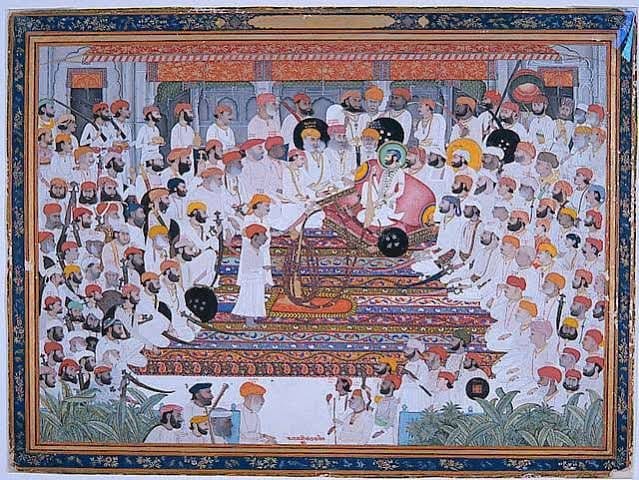
Under Maharao Raja Pratap Singh and his successor Bakhtawar Singh (r. 1791-1815), the court established a dedicated royal atelier. Alwar attracted master painters from the waning Mughal court in Delhi, notably Dalchand and Saligram. Unlike Delhi, which turned toward secular imperial portraits, the artists in Alwar merged Mughal draftsmanship with the intense devotional landscape of Braj. In the lakeside marble pavilions of the City Palace, the pastimes of Krishna were visualised with delicate naturalism, combining royal courtly manners with the pastoral innocence of the cowherds.
Visual Grammar & Iconography
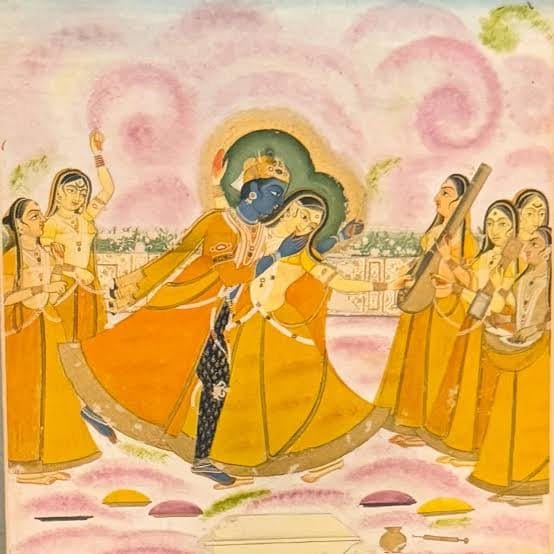
- The Softly Rounded Profile: Characters feature refined, naturalistic profiles. Figures have gentle sloping foreheads, long almond-shaped eyes without exaggerated corners, and soft rounded chins, reflecting the quiet modesty of Braj.
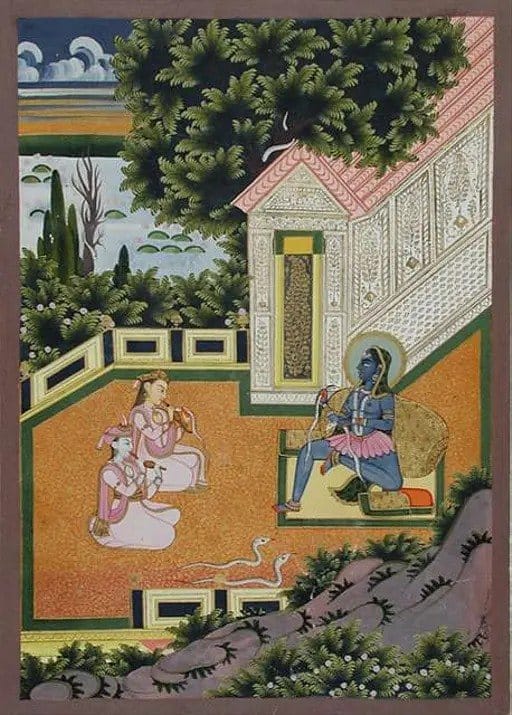
- Gossamer Drapery: Alwar masters inherited imperial Mughal expertise in rendering transparent textiles. Radha is depicted in delicate cholis and translucent odhanis decorated with microscopic gold-printed floral sprigs (butis) that reveal the posture of her arms beneath.
- Elaborate Ruled Borders (Khat): A hallmark of the Alwar studio is the frame. Folios are encased in multi-layered, ruled borders filled with scrolling gold vines, arabesques, and minute floral rosettes, creating a formal sanctum for the sacred scene.
- Water and Reflected Light: Alwar folios frequently introduce reflective water bodies, fountains, and marble terraces, showing Krishna gazing at Radha as the setting sun casts a pale pink glow across the water.
Material Anatomy & Process
The Alwar workshop adhered to traditional courtly methods:
- Burnished Wasli Sheets: Artists pasted multiple layers of handmade Sanganer paper with wheat-starch paste infused with insect-repelling neem, burnishing the sheet until it was completely grainless.
- Single-Hair Brushes: The minute detailing on garments, leaves, and eyebrows relied on brushes made from the finest hairs of mountain squirrels, held with rigid physical discipline.
- Restrained Palette
- White: Refined Makrana marble dust and zinc white for translucent fabrics and marble terraces.
- Red: Muted mineral cinnabar (hingul) and red ochre for garments and cushions.
- Green: Soft terra verde and copper verdigris (zangar) for the riverbank foliage.
- Gold: Purified shell gold applied with gum water and burnished with agate styluses to yield a soft, satin sheen.
The Literary & Spiritual Roots
- Keshavdas's Rasikapriya: Extensively illustrated for the royal library, exploring the emotional seasons of love and Radha’s interior moods (Maan and Viraha).
- Local Braj Bhasha Lyrics: Bakhtawar Singh was himself a poet of deep religious sentiment who wrote verses under the name Bakhtesh. His court artists illuminated these regional songs, portraying Krishna walking through the orchards of Nandgaon.
- The Mood of Quiet Union (Sambhoga Sringara): The atelier favored moments of quiet companionship, where Krishna and Radha sit side by side on a carpeted terrace, listening to songbirds in the Kadamba branches above.
Heritage, Lineage & Field Notes
- The Court Masters: Lineages led by Dalchand, Saligram, and later master Jamnadas preserved a distinctive Alwar idiom well into the 19th century.
- The Alwar Palace Museum: The primary collection of historical folios, illuminated manuscripts, and the famous Alwar Gulistan scroll are preserved inside the City Palace of Alwar.
- Key Archival Repositories
- Alwar Palace Museum (Rajasthan): The core historical holdings.
- National Museum, New Delhi: Master leaves from the Alwar Krishna and Rasikapriya series.
- Victoria and Albert Museum, London: Dispersed 19th-century Alwar court folios.
In Alwar, the painters avoided loud spectacle. They proved that divine presence is best captured when the brush moves softly, like a warm breeze through a grove of Kadamba trees.