The Origin & Regional Context
Along the alluvial banks of the Bhagirathi River in Murshidabad, and later centered in the terracotta temple capital of Bishnupur, Bengal cultivated one of the most sophisticated narrative textile arts in the world: Baluchari weaving.
Under the patronage of the Nawabs of Murshidabad in the 18th century, Baluchari weavers developed intricate figurative silks. However, when the capital shifted and the craft took deep root in Bishnupur under the Malla kings, the tradition underwent a profound devotional transformation. The Malla dynasty had converted to Gaudiya Vaishnavism under the guidance of Srinivas Acharya. The Mallas covered their city in monumental terracotta temples decorated with scenes of the Gita Govinda and Bhagavata Purana. The weavers of Bishnupur took these very stone carvings and translated them into the pallus of silk sarees. In Bengal, a saree was not just clothing; it was an unrolled manuscript of divine love.
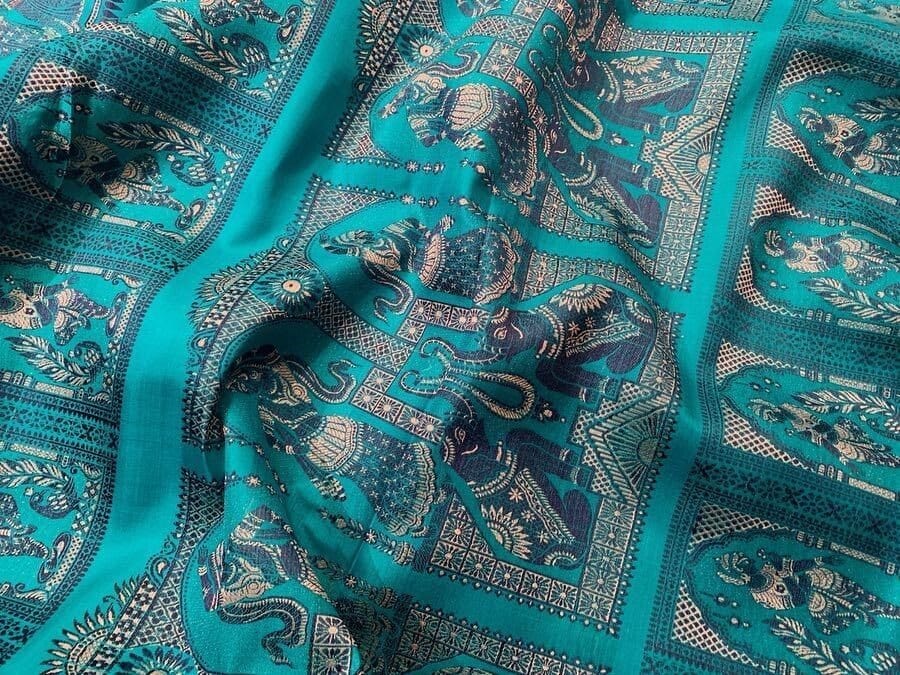
Visual Grammar & Iconography
Baluchari textiles function visually as miniature paintings executed on a loom:
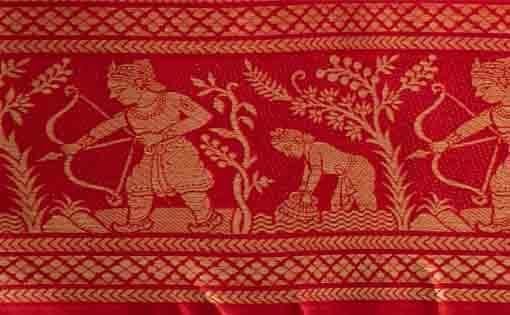
- The Narrative Pallu: The broad end-piece of the saree (pallu) is organized like an illuminated manuscript. A large central rectangular panel depicts a major lila, such as the Raas-Lila, the Kaliya Daman, or the lifting of Govardhan, surrounded by smaller square narrative registers.
- Architectural Border Niches: Narrative scenes are framed beneath cusped arched niches that mirror the terracotta temple panels of Bishnupur, creating a miniature temple facade woven in silk.
- The Terracotta Silhouette: Figures are drawn with clean, graphic profiles: large expressive eyes, sharp noses, and rounded limbs, echoing the folk energy of Bengal terracotta plaques.
- Pure Silk, No Zari: Historic Baluchari sarees used no metallic gold or silver threads (zari). The entire design was woven using unspun, dyed mulberry silk threads, creating a soft, matte relief that felt like fine embroidery.
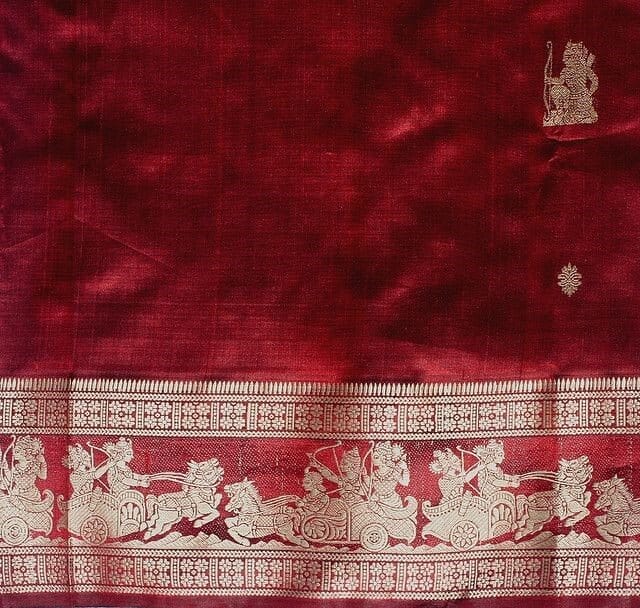
Material Anatomy & Process
The creation of a classical Baluchari saree was a monumental technical achievement:
- Pure Mulberry Silk (Murshidabad Silk): The warp and weft were woven from high-grade local mulberry silk, degummed and spun by hand to produce a dense, supple fabric.
- Natural Vegetable Dyes: Traditional color sources included:
- Cream and Red: Local madder root and lac for rich crimson fields.
- Yellow: Turmeric and palash blossoms.
- Blue: Fermented plant indigo.
- Black: Iron-gall extracts.
- The Jala Drawloom System: Before modern punch cards, Baluchari weavers used the intricate Jala technique. A master weaver spent weeks tying hundreds of cotton strings onto a master harness, coding the intricate figurative design thread by thread. Two weavers worked together on the loom: a drawboy pulled the jala strings above, while the master weaver threw the shuttles below to insert the supplementary silk weft. A single saree took up to six months to complete.
The Literary & Spiritual Roots
Baluchari weaving is an expression of Gaudiya Vaishnava devotion:
- Jayadeva's Gita Govinda: Cantos describing the secret meetings of Radha and Krishna in the groves of Vrindavan were woven into border bands, turning the hem of the garment into a line of poetry.
- The Nouka Vilas (The Boat Lila): A favorite theme of Bengal weavers was the boat pastimes, where Krishna disguises himself as a boatman to ferry Radha and the gopis across the turbulent Yamuna, demanding love as his toll.
- Sacred Dressing (Vastra Seva): Wearing a Baluchari saree during festivals was considered an auspicious act. The wearer wrapped herself within the sacred narrative, carrying the memory of Braj wherever she walked.
Heritage, Lineage & Field Notes
- Dubraj Das, the Last Master: The traditional Jala technique suffered a near-fatal collapse under colonial industrial textile imports in the early 20th century. The last legendary master, Dubraj Das, died in 1903.
- Revival at Bishnupur: In the mid-20th century, pioneering artist Subho Tagore and master weaver Akshay Kumar Das revived the craft in Bishnupur, adapting modern Jacquard punch-card systems to preserve the historic narrative patterns.
- Geographical Indication (GI): Baluchari Saree was granted Geographical Indication status in 2011 (Application No. 173), legally securing the heritage of Bankura district in West Bengal.
- Key Archival Repositories: Collections and relevant holdings include:
- Indian Museum, Kolkata: Outstanding collection of 18th and 19th-century Murshidabad Baluchari pallus.
- National Museum, New Delhi: Master narrative sarees depicting the Raas-Lila.
- Victoria and Albert Museum, London: Early colonial collections of historic Bengal silks.
On the looms of Bishnupur, devotion was not painted with a brush; it was counted thread by thread. The weavers showed that when love is woven with patience, the stories of Braj become an unbreakable fabric.