The Origin & Regional Context
Rising out of the arid sands of the Thar Desert, the Rathore kingdom of Bikaner forged an intimate alliance with the Mughal empire under Raja Rai Singh (r. 1571-1612). As military commanders serving the emperors across Gujarat and the Deccan, Bikaner's rulers assembled a sophisticated taste for imperial refinement and southern Deccani lyricism.
Unlike other Rajput kingdoms that maintained vigorous local folk lines, Bikaner built a royal studio (Karkhana) staffed largely by Muslim master artists (Ustas) who had trained in the imperial ateliers of Delhi and Agra. Working under Maharaja Anup Singh (r. 1669-1698), a celebrated scholar and collector, artists such as Ali Raza, Ruknuddin, and Nuruddin turned their delicate Mughal draftsmanship toward Vaishnava devotion. In the cool marble halls of Bikaner, far removed from the dust of the dunes, the love of Radha and Krishna was refined into an aristocratic dialogue of quiet gestures and whispered poetry.
Visual Grammar & Iconography
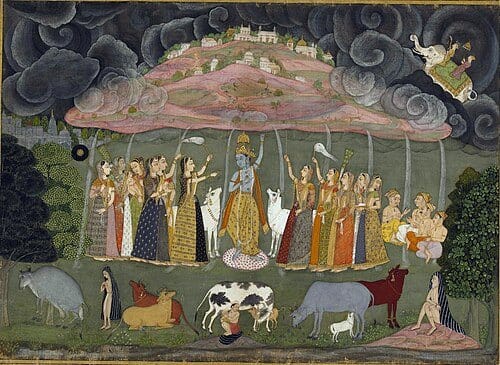
- The Muted, Pastel Atmosphere: Bikaner rejected heavy, jarring color contrasts. Palettes rely on delicate, pale tones: dusty mauve, pale pistachio green, turquoise, biscuit-cream, and faded rose pink, echoing the soft light of the desert dusk.
- The Translucent Veil (Odhani): Bikaner masters were celebrated for their skill in painting gossamer fabrics. Radha's veil is rendered with microscopic washes of white, revealing the embroidery of the bodice beneath and fluttering delicately in dry desert breezes.
- The Lyrical, Contemplative Profile: Figures possess slender, aristocratic profiles with high foreheads, slightly drooping half-closed almond eyes, and small, sensitive mouths. Physical movement is restrained; emotion is communicated through a tilted head, an outstretched hand, or a downward glance of bashful reserve (lajja).
- The Desert Horizon and Cloud Formations: Landscapes feature high, distant horizons with low rolling sand mounds and delicate, weeping trees. Skies are animated by ribbon-like clouds tinted with faint pink and lilac, signaling the cool relief of twilight.
Material Anatomy & Process
- Agate-Burnished Wasli: Thin layers of handmade rag paper were laminated using fine rice paste and burnished face down with hard agate stones until the surface possessed the smoothness of silk.
- Microscopic Shading (Pardaz): Bikaner painters rarely used flat color blocks. Volume was built using Pardaz, a technique of applying thousands of microscopic parallel brush strokes with single-hair brushes, creating velvety transitions across cheekbones and drapery folds.
- Refined Pigment Chemistry:
- Blue: Washed lapis lazuli, layered in delicate transparent glazes rather than opaque blocks.
- Greens: Soft terra verde mixed with orpiment yellow to produce pale sage and pistachio tones.
- White: Refined zinc white and calcined shell white, applied with needle tips to render strings of natural pearls.
- Gold Work: Delicate application of shell gold (purified gold ground with gum), lightly burnished to catch candlelight without dominating the composition.
The Literary & Spiritual Roots
- Keshavdas’s Rasikapriya: The primary literary compass was the Rasikapriya, composed by Keshavdas of Orchha. Bikaner artists illustrated extensive suites detailing the exact emotional classifications of love (Nayika Bheda), portraying Radha’s wounded pride (Maan), the mediation of her friends (Sakhis), and Krishna’s quiet repentance.
- The Satsai of Bihari: The compressed, couplet-form poetry of Bihari was widely illustrated, turning single poetic metaphors of glance and separation into full-page visual meditations.
- The Rasa of Refined Love (Sringara): Devotion in Bikaner was not expressed through ecstatic dancing or weeping. It was experienced as an internal, intellectual contemplation of beauty, where the lover and the divine soul meet through courtesy, dignity, and quiet reconciliation.
Heritage, Lineage & Field Notes
- The Usta Lineages: Unlike many anonymous ateliers, Bikaner painters signed and dated their work on the reverse (pithika), noting the artist's name, parentage, and the date of completion. Lineages founded by Ruknuddin and Nuruddin passed down these techniques for generations.
- The Khajanchi and Royal Collections: The finest historical folios survived in the royal archives of the Junagarh Fort in Bikaner and the famed collection of Sri Moti Chand Khajanchi.
- Key Archival Repositories:
- National Museum, New Delhi: Premier holdings of signed Nuruddin Rasikapriya folios.
- Smithsonian National Museum of Asian Art, Washington D.C.: Key illustrated leaves from the 1690 Rasikapriya suite.
- Lallgarh Palace Archives, Bikaner: Royal family collections and court records.
In Bikaner, love did not need to shout to be felt. It whispered through layers of sheer muslin, proving that silence can hold as much devotion as song.