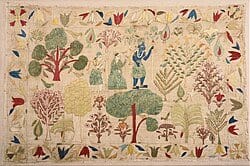
The Origin & Regional Context
Guarded by the snow-covered peaks of the Pir Panjal along the upper gorge of the Ravi River, the principality of Chamba remained untouched by plains warfare. In this mountain refuge, sacred art did not belong solely to male court painters working in palace ateliers. It moved directly into the inner domestic courtyards (zenana), where royal and noble women turned fine needlework into a living school of devotion.
While painters of the Guler and Basohli lineages sought patronage under Raja Umed Singh (r. 1748-1764) and Raja Raj Singh (r. 1764-1794), the women of the household developed a parallel tradition: the Chamba Rumal. The rumal was never a common handkerchief. It was a square ceremonial textile used to drape brass trays of wedding gifts, cover temple offerings, and wrap sacred icons. Here, the romance of Braj was translated from pigment on paper into silk on unbleached muslin, preserving the intimacy of Vrindavan in an unbroken domestic ritual.
.
Visual Grammar & Iconography
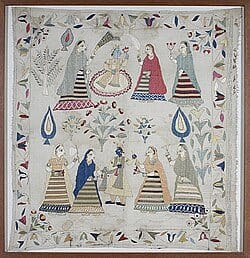
The Chamba Rumal functions visually as a miniature painting translated into thread:
- The Sacred Circular Dance (Rasa-Mandala): The definitive composition of Chamba is the circle of the Raas. At the exact center stands the Yugal Sarkar (Radha and Krishna beneath a flowering Kadamba tree). Radiating outward is a concentric wheel where Krishna multiplies himself to dance with each alternate gopi, capturing infinite divine omnipresence on a flat square cloth.
- The Master Cartoon (Charba): The draftsmanship was not casual. Court miniature painters first drew the outlines directly onto the fine cotton fabric using charred willow charcoal and fine black ink brushes. The women of the household then filled those lines with colored silk threads, ensuring that the embroidery maintained the sophisticated proportions and graceful postures of Pahari miniature art.
- The Interlocking Floral Border (Hashiya): Every rumal is bound by a wide outer border of scrolling vines, buds, wild parrots, and peacocks. This border acts as a consecrated threshold, enclosing the sacred space of the grove and separating the divine play from the outer world.
- Lyrical Facial Features: Figures retain the soft, gentle oval profiles of the late Guler-Pahari idiom: long lotus eyes (padma-netra), arched eyebrows, and modest, bashful smiles that evoke the tenderness of pastoral love.
Material Anatomy & Process
The technical execution of a classical Chamba Rumal demands extraordinary physical discipline:
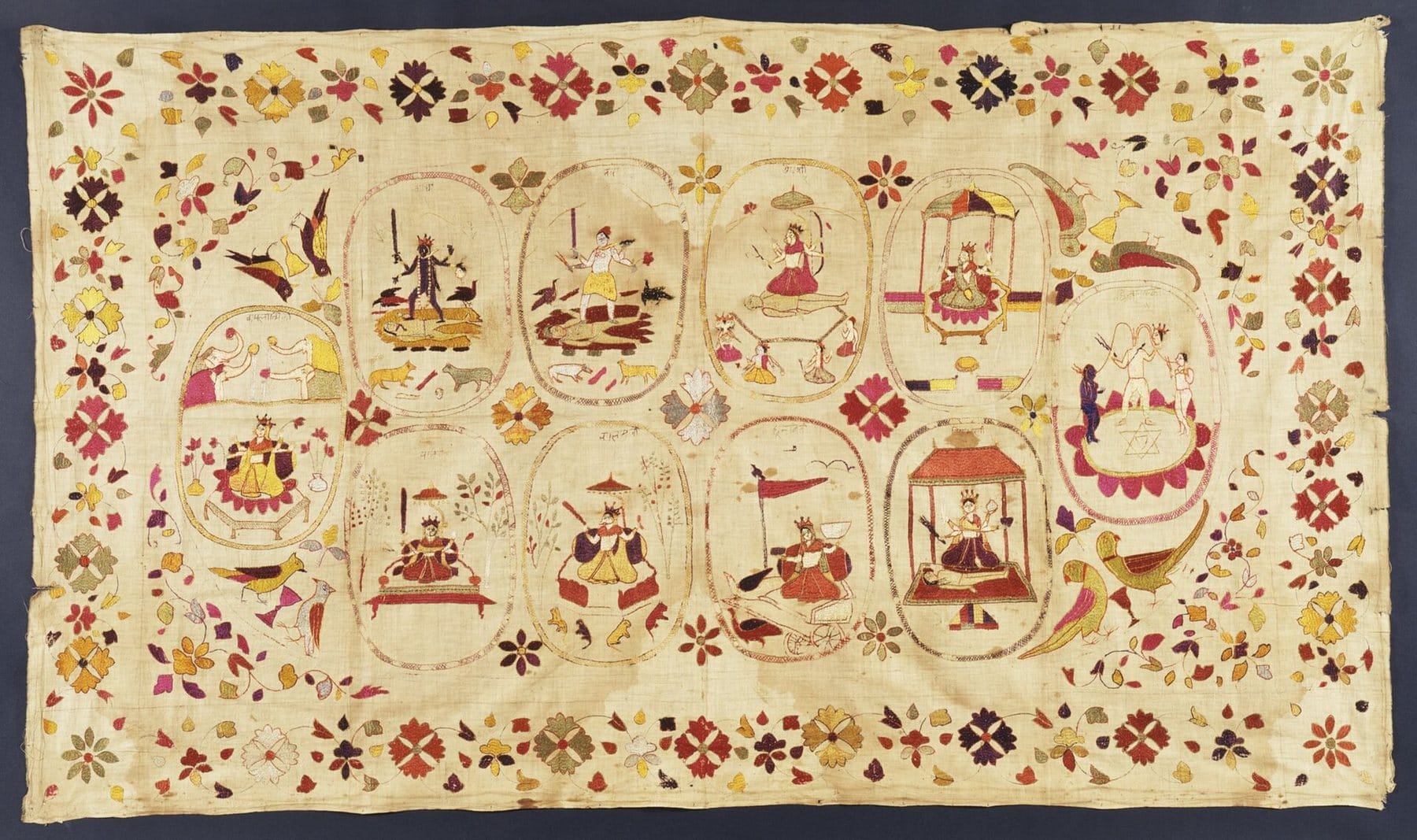
- The Cotton Ground (Khaddar or Malmal): The base is finely woven, unbleached handspun cotton (malmal) or lightweight handloom cloth (khaddar). Its unbleached, ivory-cream tone provides the warm, natural background for the embroidery.
- Unspun Floss Silk (Patt): The embroidery uses raw, untwisted silk floss known as patt. Because the silk threads are unspun, they lie flat on the cotton ground, creating a continuous, mirror-like sheen that catches light like wet paint.
- The Reversible Double Satin Stitch (Do-Rukha): The defining mark of a true Chamba Rumal is the Do-Rukha stitch. The needle carries the silk thread forward and backward across the surface simultaneously, filling the front and back of the cloth with identical stitches. No knots, loose ends, or messy thread crossings are ever permitted; both faces of the textile are completely indistinguishable.
- The Natural Dye Palette:
- Yellow: Turmeric and dried palash blossoms for Krishna's pitambar.
- Red & Vermilion: Madder root (manjistha) for Radha's skirts and bridal borders.
- Blue: Fermented plant indigo for Krishna's complexion.
- Green: Dried bilva leaves and bark extracts for forest thickets.
The Literary & Spiritual Roots
The visual poetry of the Chamba Rumal is derived directly from medieval Vaishnava classics:
- Jayadeva's Gita Govinda: The sensual, musical Sanskrit verses of the Gita Govinda were the most popular subject. Entire rumals were divided into narrative squares detailing Radha's sorrow in separation (Viraha), the messenger's counsel, and the joyful reconciliation in the groves of Vrindavan.
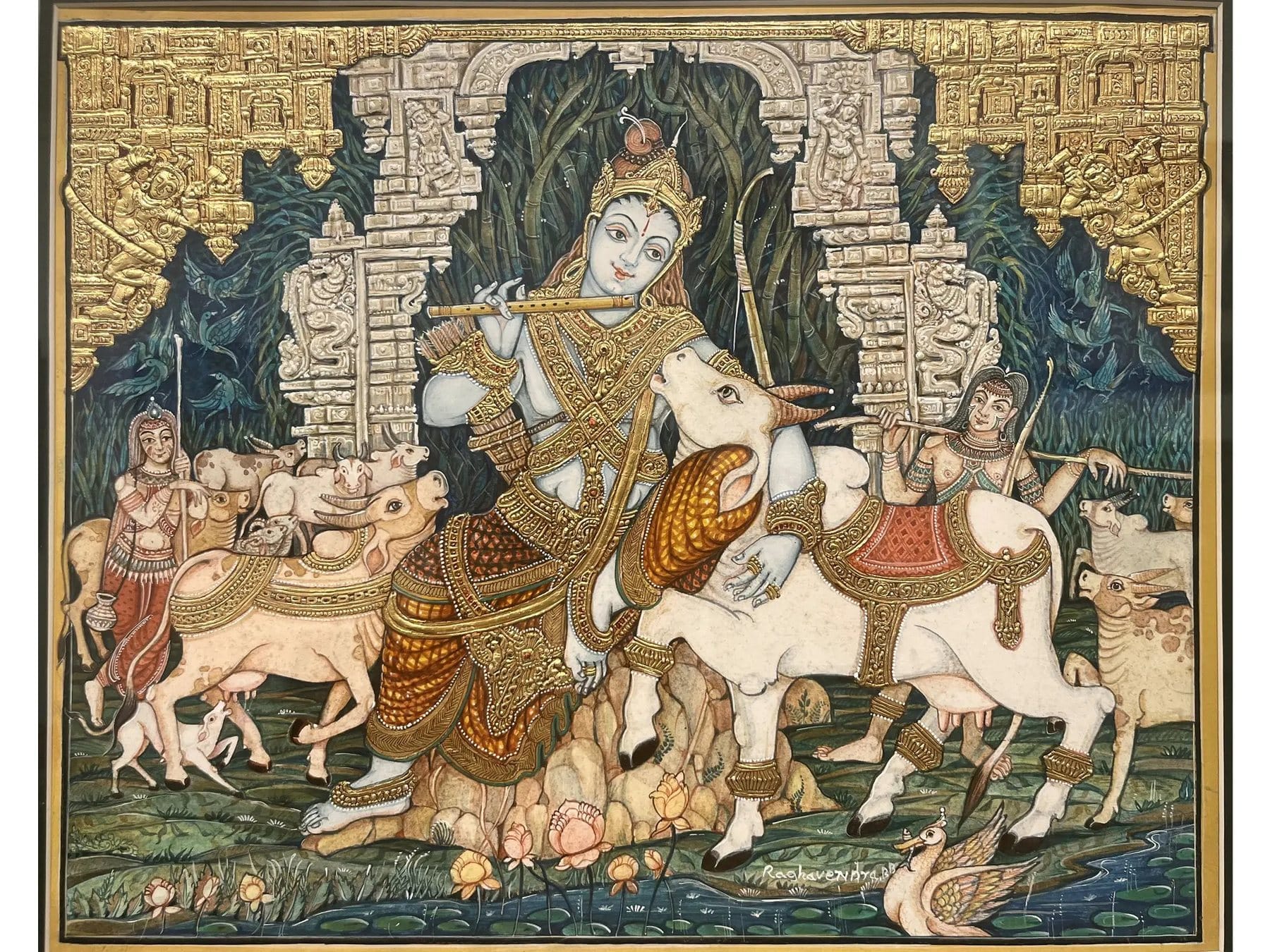
- The Tenth Book of the Bhagavata Purana: Scenes of Krishna stealing the clothes of the cowherd girls (Vastra Harana), lifting Mount Govardhan, and grazing calves through alpine meadows reflect the pastoral ethos of the hills.
- The Rasa of Tenderness (Vatsalya & Madhurya): Because these cloths were embroidered by mothers, grandmothers, and young brides as bridal dowry gifts (dahej), the emotional weather of the rumal is infused with maternal blessing and pure, unconditional affection.
Heritage, Lineage & Field Notes
- The Historic Royal Patronage: While rural women made simpler domestic rumals, the finest court examples were commissioned within the royal palace of Chamba (Rang Mahal), where master painters and court ladies worked in close collaboration.
- Maheshi Devi and Modern Revival: With the decline of Himalayan royal patronage in the mid-20th century, the craft faced extinction. Legendary artisan Maheshi Devi received the National Award in 1965 for reviving the authentic Do-Rukha technique, laying the groundwork for craft societies and state initiatives that protect the tradition today.
- Geographical Indication (GI): Chamba Rumal was granted Geographical Indication status in 2008, legally protecting the craft against machine-embroidered imitations and preserving the heritage of Chamba district in Himachal Pradesh.
- Key Archival Repositories:
- Bhuri Singh Museum, Chamba: The primary historical collection of 18th and 19th-century royal rumals.
- National Museum, New Delhi: Master ceremonial cloths illustrating the Maha-Raas.
- Victoria and Albert Museum, London: Historical rumals presented to British officials during the colonial era.
In Chamba, the needle refused to leave a knot on either side of the cloth. It mirrored the philosophy of Braj itself: love so complete, and so pure, that it reveals the same perfection no matter which way you turn it.