The Origin & Regional Context
Rising above the rocky scrub of western Rajasthan, the desert kingdom of Marwar (Jodhpur) was shaped by endless sand dunes, fierce clan warfare, and sweeping winds. While courts closer to the Yamuna painted Vrindavan as a dense, riverine orchard, Jodhpur saw the childhood of Krishna through the lens of its own vast, sun-baked landscape.
Under Maharaja Abhai Singh (r. 1724-1749) and Maharaja Bakhat Singh (r. 1751-1752), Jodhpur painting threw off the subdued politeness of late Mughal court art to reclaim its indigenous folk vitality. When Maharaja Man Singh (r. 1803-1843) took the throne, the atelier experienced a creative explosion. Though famously devoted to the esoteric Nath yogic cult, Man Singh’s court produced monumental manuscript suites celebrating the Bhagavata Purana and the songs of Surdas. In the open pavilions of Mehrangarh Fort, Braj was re-imagined not through modest domestic scenes, but as an ecstatic spectacle of radiant gold, wind-whipped drapes, and fearless devotion.
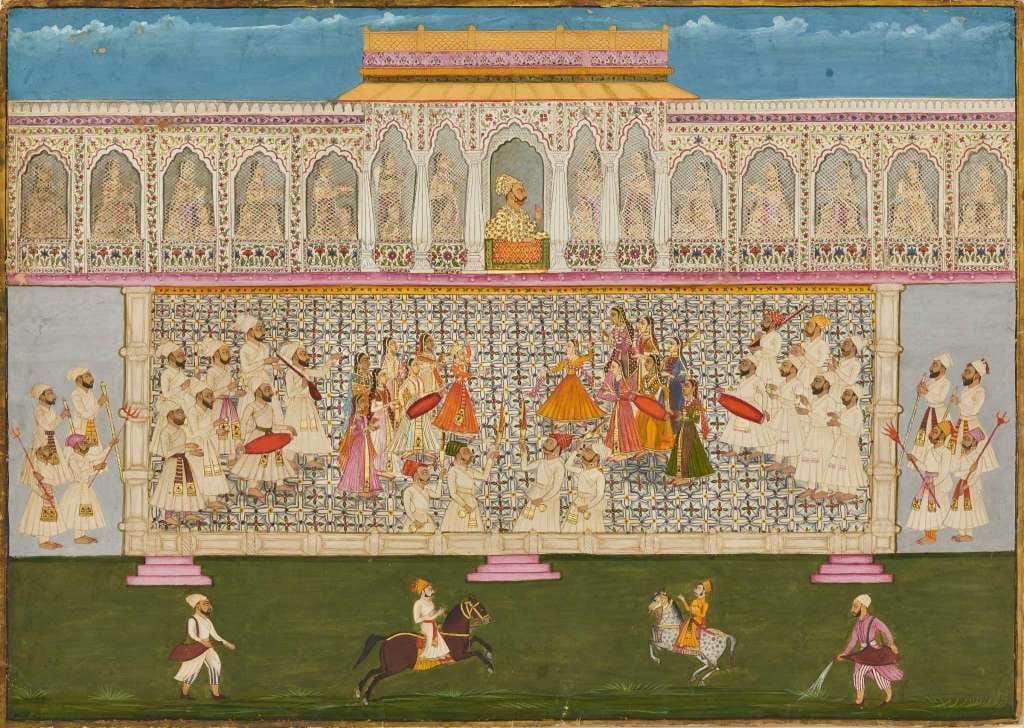
Visual Grammar & Iconography
Jodhpur painting is immediately identifiable by its soaring physical scale, kinetic figures, and bold desert palette:
- The Dramatic Marwari Eye: Figures in Jodhpur feature oversized, upward-tilting lotus eyes that sweep boldly toward the earlobe. Accompanying these are strong jaws, proud noses, and curled tendrils of hair falling over the temple, expressing an aristocratic, fierce vitality.
- The High Spiraling Turban (Chira): Men, including Krishna and his cowherd companions, are crowned with the exaggerated Marwari turban: a tall, conical, forward-sloping headdress tied in swirling layers of red, gold, and saffron, distinct from any other school in Rajasthan.
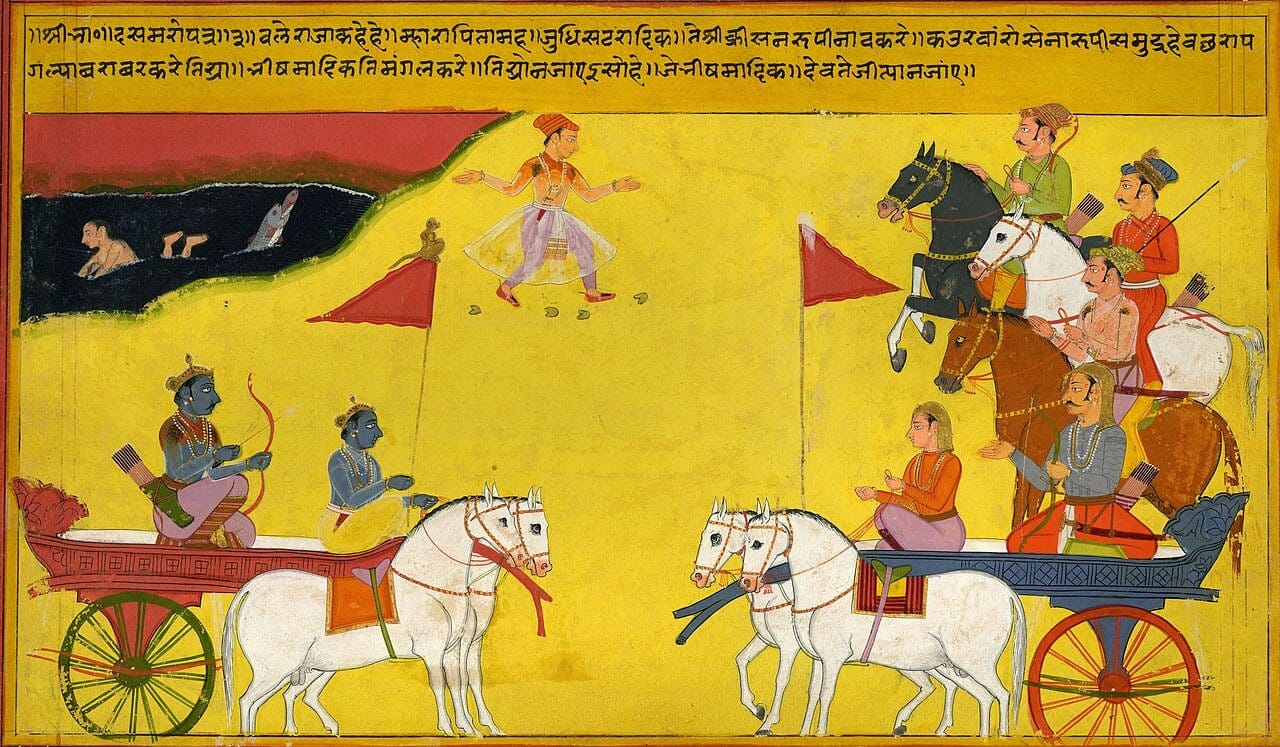
- The Blazing Yellow Earth: Landscapes are rarely painted in cool river greens. Jodhpur artists washed their sheets in expansive fields of warm yellow ochre, deep saffron, and glowing mineral orange, capturing the fiery afternoon light of the Thar desert.
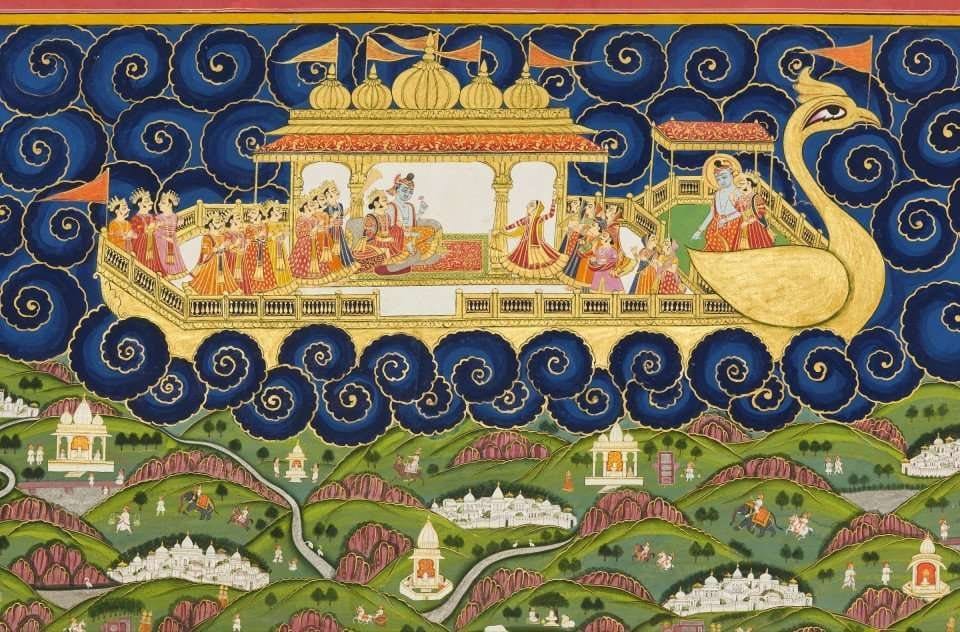
- Billowing Drapery and Kinetic Motion: Garments do not hang straight; they catch the desert wind. Skirts flare into wide geometric bells, transparent dupattas float like sails behind galloping horses, and river currents coil in bold calligraphic spirals.
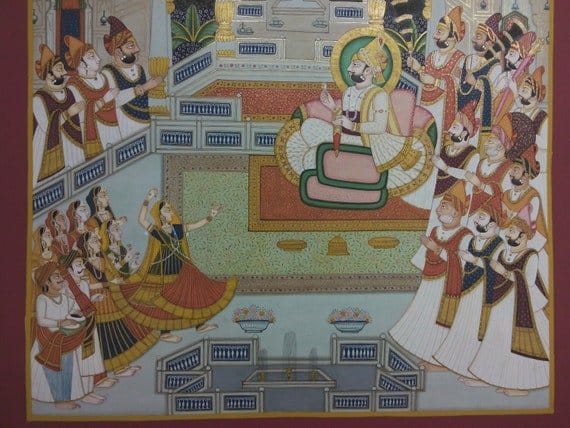
Material Anatomy & Process
The bold surfaces of Jodhpur paintings were created through robust studio materials:
- Heavy Sanganeri Wasli: Artists worked on thick, multi-layered sheets of handmade rag paper. These sturdy supports were heavily polished with agate stones, giving the surface a mirror-smooth ground that resisted the abrasive, dry heat of the desert.
- Earth and Mineral Pigments
- Yellow: Marwar's signature color was derived from local desert clays, enriched with imported mineral orpiment (haritala) for brilliant golden halos.
- Red: Pure cinnabar (hingula) and red ochre (geru), applied in broad fields for backgrounds and palace canopies.
- Blue: Dense vegetable indigo, often combined with lapis lazuli for Krishna’s regal form.
- White: Pulverized gypsum and conch-shell powder, applied in thick dots to simulate strings of royal pearls.
- The Rapid Black Contour: Compositions were finalized using strong, sweeping outlines drawn with horsehair brushes, prioritizing bold movement and silhouette over microscopic detailing.
The Literary & Spiritual Roots
Jodhpur’s Vaishnava folios were the direct visual embodiment of classical devotional poetry:
- The Sur Sagar of Surdas: Jodhpur artists produced some of the most extensive illustrated cycles of Surdas's verses. The poetry celebrates Krishna as the divine child (Bal Gopala) and the cowherd companion (Sakhya Bhava). Scenes of butter-stealing, Yashoda’s scolding, and playful pasture wrestling are depicted with vivid regional humor.
- The Rasikapriya and Gita Govinda: The royal atelier illuminated multiple suites of Keshavdas’s Rasikapriya, examining Radha’s psychological states with dramatic, sweeping gestures of wounded pride and reconciliation.
- The Ecstasy of Bhakti: In Jodhpur, devotion was never quiet or secretive. It carried the roar of the desert wind: joyous, bold, and physically unrestrained, treating the love of God as a celebration open to the entire kingdom.
Heritage, Lineage & Field Notes
- Master Painters: Celebrated court masters like Dalchand, Amar Das, and Bulaki passed down compositional sketches through generations, establishing identifiable family ateliers within the Mehrangarh palace.
- Mehrangarh Museum Trust: Unlike dispersed schools, the core historical collection of Jodhpur miniature manuscripts remains intact within the Mehrangarh Fort Museum in Jodhpur, preserved by the royal family trust.
- Key Archival Repositories
- Mehrangarh Museum Trust, Jodhpur: The primary worldwide collection of 18th and 19th-century Marwar folios.
- National Museum, New Delhi: Master leaves from the Jodhpur Bhagavata and Sur Sagar suites.
- San Diego Museum of Art (Edwin Binney 3rd Collection): Rare early Marwar folios.
In Jodhpur, the painters refused to let Braj remain hidden in the shade. They led Krishna out under the vast sky of the desert, proving that love burns brighter where the land is most fierce.