The Origin & Regional Context
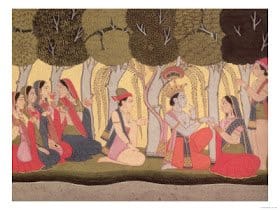
Deep within the higher ranges of the Himalayas, where the Beas River cuts through the snow-bound Kullu Valley, developed one of the most expressive folk traditions of Pahari art. Known historically as Kulantapitha (the end of the habitable world), Kullu was an ancient center of local village deities (Devtas) and shamanic ritual.
In the late 17th and early 18th centuries, under Raja Man Singh (r. 1688-1719) and his successors, Vaishnavism entered the valley. The divine idol of Raghunathji was installed as the supreme sovereign of Kullu. Working in the secluded palace of Shangri and the royal seat at Sultanpur, local artists developed an extraordinary visual language. While other schools sought refinement, Kullu retained its primal folk power. In Kullu, the pastures of Braj were transformed into high alpine meadows, where Krishna danced with a wild, unrestrained joy that matched the spirit of the valley.
Visual Grammar & Iconography
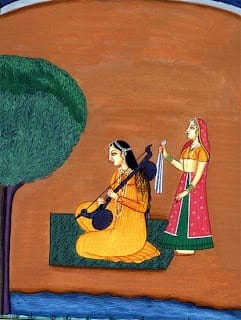
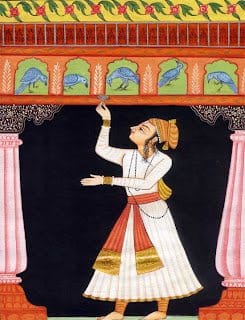
Kullu painting is instantly recognized by its raw linear energy, expressive distortion, and unmixed primary colors:
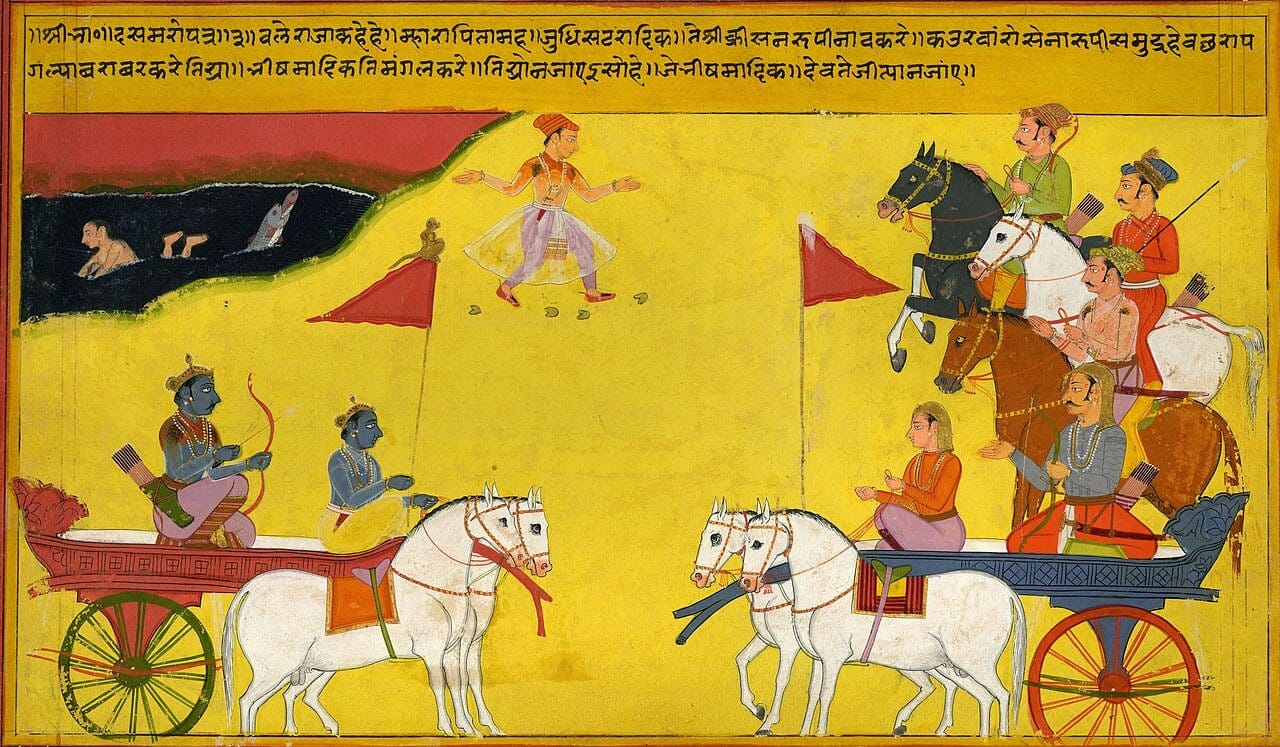
- The Bird-Like Profile: Figures possess sharp, stylized profiles with large, circular eyes that look outward with bird-like alertness. Noses are prominent and slightly hook-shaped, while chins are small and rounded, creating an unmistakable folk vitality.
- Stylized Alpine Botany: Trees are not painted naturalistically. They are composed as flat, rhythmic rosettes, pine-like clusters, and rounded geometric masses of green adorned with giant stylized teardrop leaves and circular blossoms.
- Saturated Primary Grounds: Compositions sit upon blistering fields of unmodulated color: fiery cinnabar red, hot turmeric yellow, and deep earth green, generating an emotional voltage that needs no shading.
- Energetic Movement: Figures move with vigorous, springy steps. Krishna's yellow pitambar flares outward in sharp angular folds, and his arms sweep wide in gestures of command and joy.
Material Anatomy & Process
The rustic execution of Kullu folios reflects indigenous mountain materials:
- Coarse Mountain Paper: Kullu artists used thick, rough handmade paper produced from the inner bark of local Daphne shrubs. The paper was treated with rice sizing and burnished, retaining an organic, textured tooth.
- Mineral and Earth Tempera
- Yellow: Raw mountain peori clay and bright orpiment (haritala).
- Red: Rich mineral cinnabar (hingul) and local red oxide.
- Green: Coarse malachite and green earths.
- Black: Heavy charcoal and lampblack, applied with thick confident brush strokes.
The Literary & Spiritual Roots
Kullu art was guided by fundamental Vaishnava narratives interpreted through village folklore:
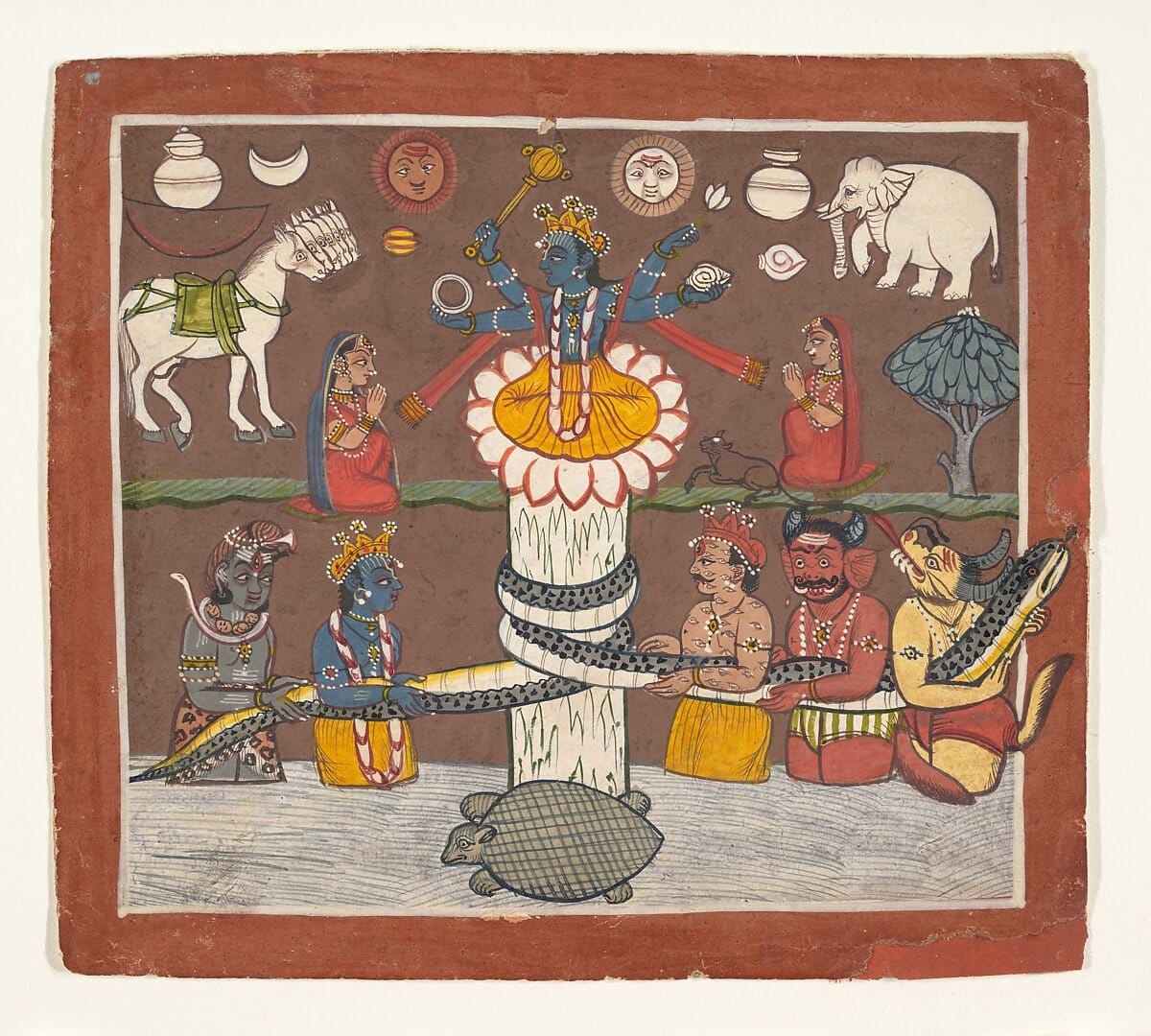
- The Shangri Series: The greatest monument of Kullu painting is the Shangri manuscript suite, comprising hundreds of folios illuminating the Ramayana and the Tenth Book of the Bhagavata Purana.
- The Pastoral Miracles: Kullu painters celebrated Krishna’s conquest over primeval forest monsters: Aghasura the python, Bakasura the crane, and Kaliya the serpent. These stories resonated deeply in a valley where wild nature was an everyday reality.
- Folk Ecstasy (Sahaja Bhakti): Devotion in Kullu was direct and uncomplicated by intellectual doctrine. The paintings carry the infectious, dancing energy of the Kullu Natti folk dance, treating Krishna as a living, joyous presence in the mountains.
Heritage, Lineage & Field Notes
- The Shangri Lineages: The artists responsible for the Shangri folios remain largely anonymous, though their hands show an unbroken lineage of local painters working across three generations.
- Discovery by W.G. Archer: The style was formally identified and documented by British art historian W.G. Archer through collections preserved by the descendants of the Shangri royal house.
- Key Archival Repositories
- National Museum, New Delhi: Major repository of the historic Shangri Bhagavata folios.
- Bharat Kala Bhavan, Varanasi: Key folios illustrating Krishna's cowherd pastimes.
- Victoria and Albert Museum, London: Early Shangri leaves.
In Kullu, the painters did not paint for courtly critics. They painted with the bright, fierce colors of the earth, proving that the love of Braj belongs as much to the mountain village as to the royal palace.