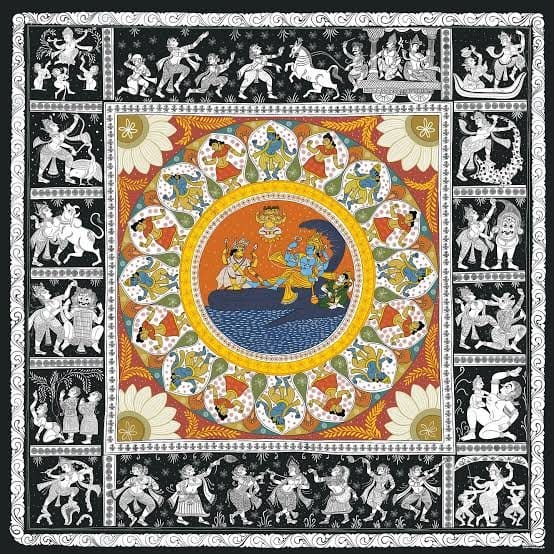
The Origin & Regional Context
Tucked between the forested cliffs of the Western Ghats and the Arabian Sea in southern Maharashtra, the kingdom of Sawantwadi was an ancient center of royal craftsmanship. In the 18th century, under the patronage of the Khem Sawant Bhonsle dynasty, Sawantwadi became the premier seat of an extraordinary craft: Ganjifa.
Originally an aristocratic card game imported from Persia, Ganjifa was completely transformed by Indian craftsmen into a devotional medium. The traditional Persian suits were replaced by the Dasavatara (the ten incarnations of Vishnu) and the pastimes of the Bhagavata Purana. Hereditary painters known as Chitrakars lived in the royal shadow of Sawantwadi Palace, producing circular, hand-painted gaming discs. In Sawantwadi, playing a game was an act of devotional remembrance: every time a card was dealt, the name and form of Krishna was invoked into the hands of the players.
Visual Grammar & Iconography
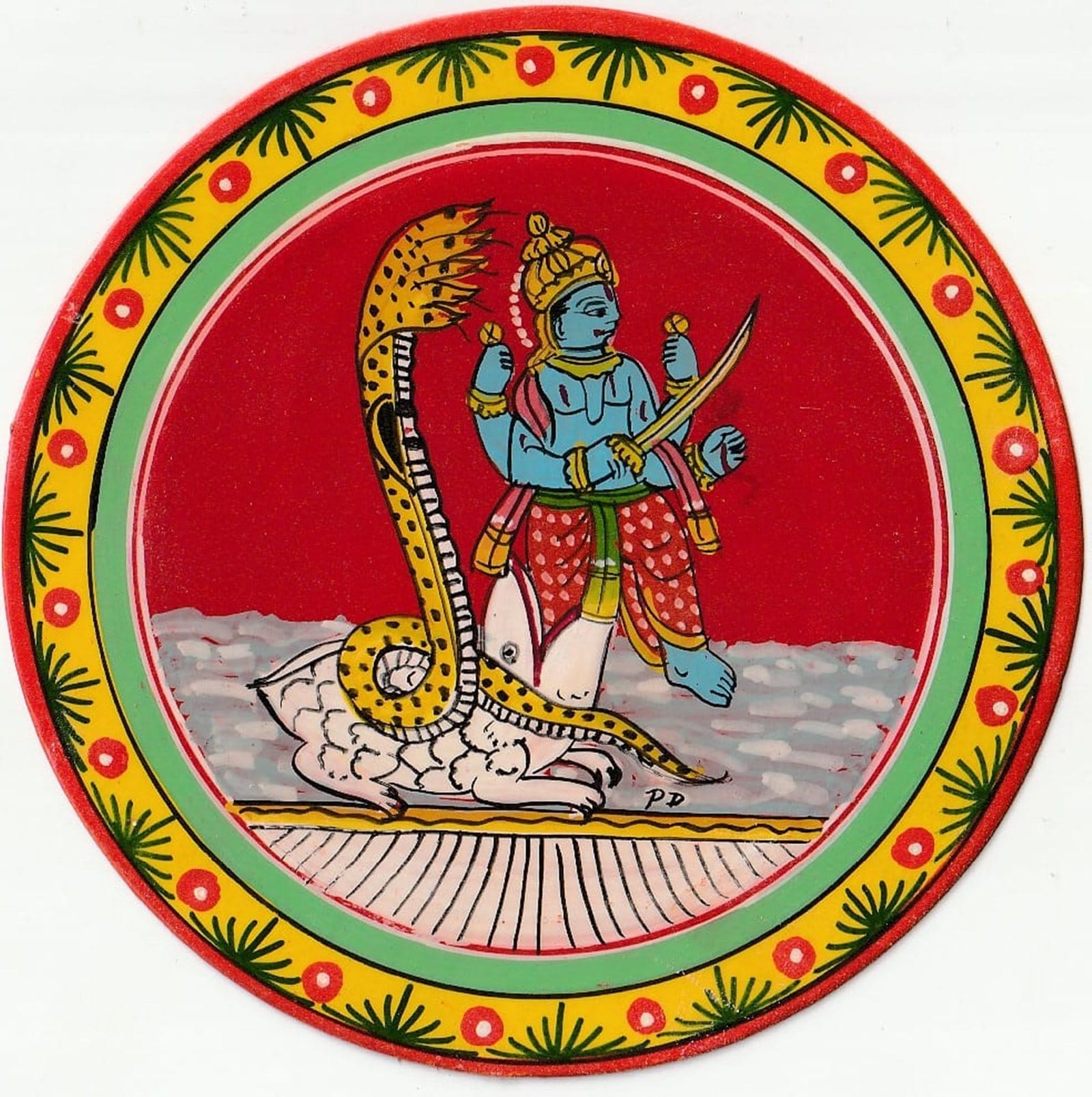
Ganjifa cards are governed by miniature discipline, circular geometry, and clear iconographic symbols:
- The Circular Canvas: Every card is a perfect round disc, typically two to three inches in diameter. The circular frame mirrors the cosmic wheel (Chakra) and the mandala of the Raas.
- The Sovereign Central Deity: On the master card (the Raja or King), Krishna sits enthroned or stands in the graceful three-fold bend (Tribhanga), holding his flute beneath a stylized parasol. On lower numerical cards, the symbols of his pastimes, butter pots, flutes, and cowherd staffs, are repeated in rhythmic numbers.
- Sharp Folk Profiles: Characters possess sharp profile views with large, wide fish-shaped eyes, pointed noses, and dark curly hair adorned with peacock feathers.
- Saturated Lacquered Grounds: The backgrounds are laid in solid, vibrant mineral fields: deep green, cinnabar red, turmeric yellow, and coal black, sealed beneath an enamel-like lacquer.
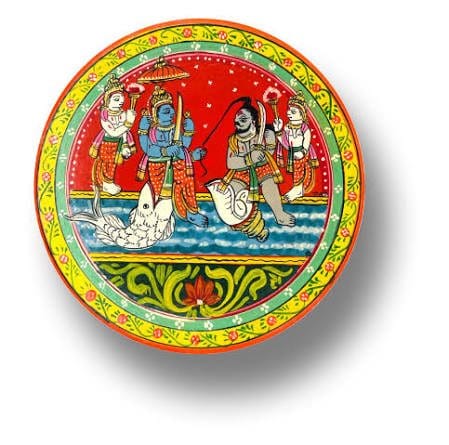
Material Anatomy & Process
The manufacture of Sawantwadi Ganjifa is a labour-intensive, multi-week craft:
- The Base Support: Discs are cut from waste cotton cloth or multiple layers of handmade paper, glued together with cooked tamarind-seed paste (kaitha katha). The discs are beaten with stones and coated with a paste of fine white clay and gum.
- Mineral Pigment Painting
- Red: Pulverized cinnabar (hingul).
- Yellow: Turmeric and mineral orpiment.
- Blue: Indigo extract.
- White: Crushed conch shells and chalk white.
- Gold: Liquid gold paint applied to crowns, thrones, and borders.
- The Lacquer Finish: Once painted, each card is coated with natural tree resin (lac) and baked in the sun. The lacquer seals the pigments, making the cards waterproof, durable, and glossy like polished ivory.
The Literary & Spiritual Roots
Ganjifa art is directly anchored in the Dasavatara Stotram of Jayadeva and the Bhagavata Purana:
- The Eighth Incarnation: In the Dasavatara suit, Krishna is celebrated as the climactic eighth incarnation (or the supreme source of all avatars). His cards illustrate the victory over Kamsa, the lifting of Govardhan, and the flute-song in the forest.
- Devotion through Play (Lila): The philosophy of Ganjifa reflects the Hindu concept of Lila: the universe as a divine game played by God. Dealing the cards was regarded as a sacred duty (Seva) that kept the holy stories alive in everyday social life.
- The Memory of the Name (Nama Smarana): Players were required to announce the name of the deity on each card as they played it, turning an afternoon pastime into an unbroken repetition of the holy names of Krishna.
Heritage, Lineage & Field Notes
- The Sawantwadi Lacquerwares: Following the decline of royal patronage, the craft was kept alive through the personal initiative of the royal family of Sawantwadi, particularly Satvashiladevi Bhonsle, who established workshops inside the palace grounds.
- Geographical Indication (GI): Sawantwadi Ganjifa cards and lacquerware hold official GI status, legally preserving the authentic traditional techniques of the Chitrakar community.
- Key Archival Repositories
- Sawantwadi Palace Museum (Maharashtra): The living workshop and primary archival collection.
- Crafts Museum, New Delhi: Master historical sets of Dasavatara Ganjifa.
- Victoria and Albert Museum, London: Historic 18th and 19th-century Ganjifa packs.
In Sawantwadi, the story of Braj was held directly in the palm of the hand. It showed that devotion need not be locked away in temples: it can live in the simple circle of a painted card, passed from hand to hand across generations.