The Origin & Regional Context
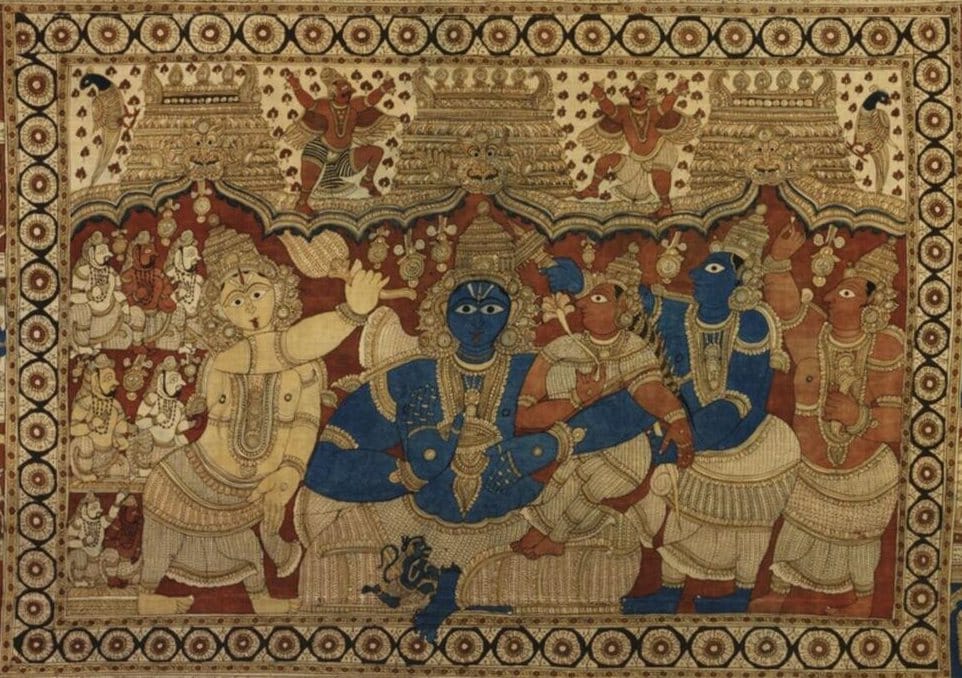
Along the banks of the Swarnamukhi River in the Chittoor district of Andhra Pradesh lies Srikalahasti, an ancient pilgrimage center famed for its towering Shiva temple. Yet inside this Shaivite stronghold grew one of the most vibrant Vaishnava narrative traditions of Southern India: freehand Kalamkari.
The word joins kalam (pen) and kari (craftsmanship). Unlike the coastal trading hub of Machilipatnam, which used carved wooden blocks to mass-produce decorative floral textiles for European and Persian markets, Srikalahasti remained entirely a freehand drawing tradition (Chitra-Kalamkari). Hereditary families of artists known as Balijas lived along the riverbank, producing monumental painted hangings (Thoranam and Kalamkari Patas) for temple sanctums, temple chariots (Rathas), and pillared courtyards. During temple festivals, when priests chanted verses from the Bhagavata, these painted cloths were unrolled across stone pillars so pilgrims could follow the sacred narratives frame by frame.
Visual Grammar & Iconography
Srikalahasti Kalamkari possesses an architectural, narrative grandeur:
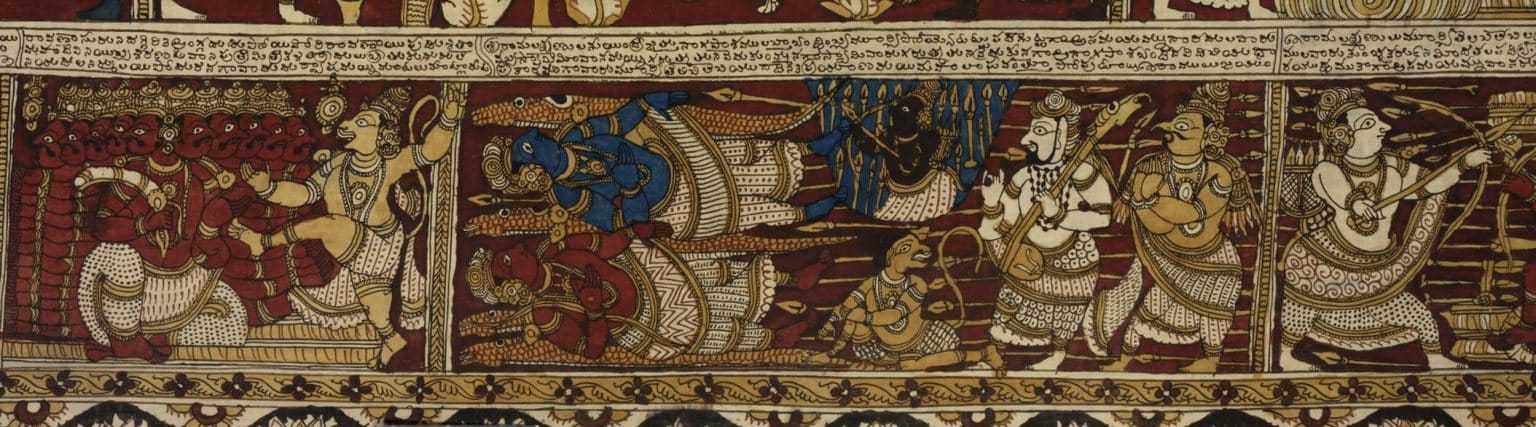
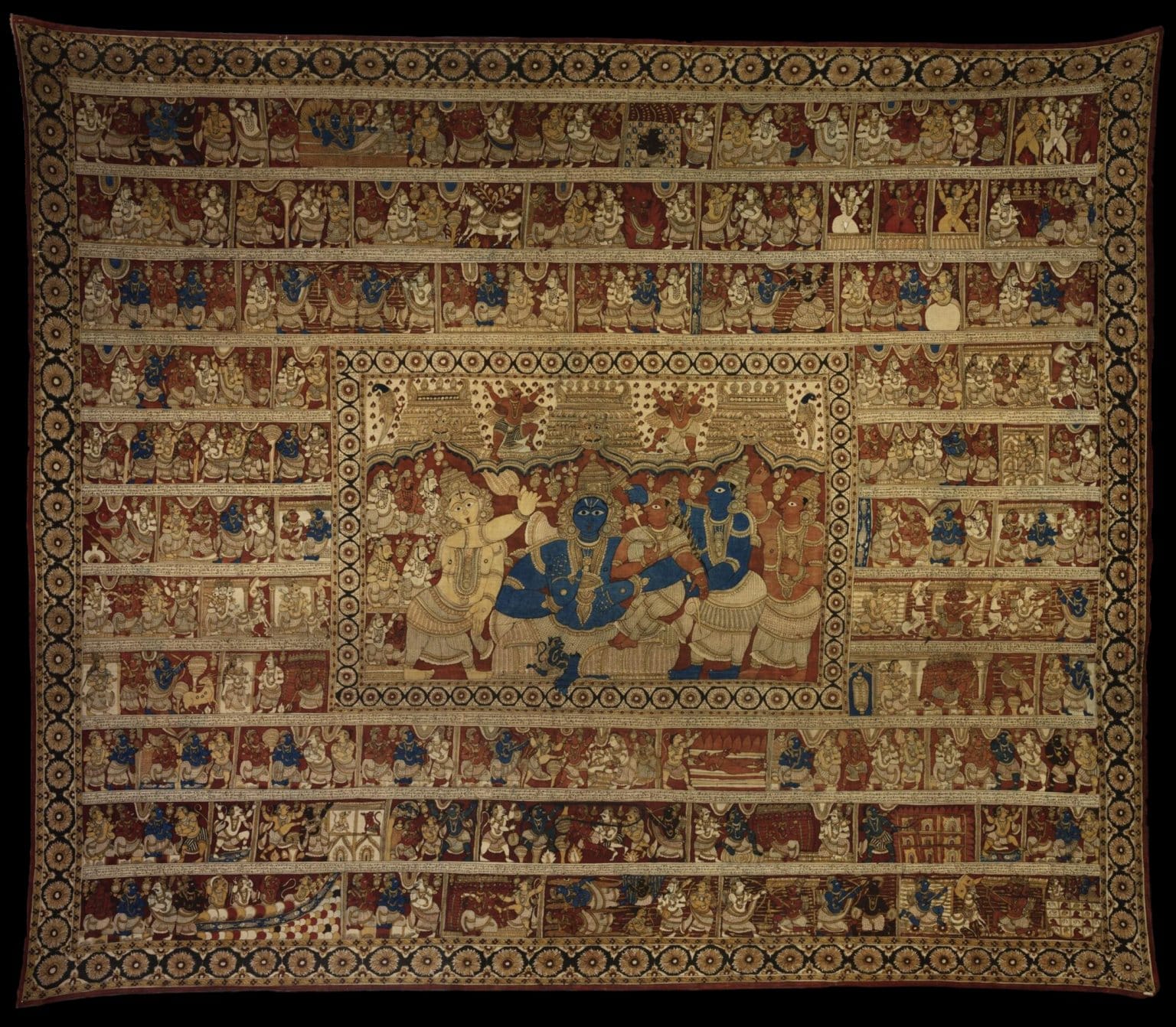
- The Register-Based Visual Comic: Compositions are arranged in continuous horizontal or vertical registers (Pattis). The story moves across the fabric like a visual epic: Krishna’s miraculous birth in the prison of Mathura, Vasudeva crossing the roaring Yamuna, the butter-stealing escapades, and the climactic destruction of Kamsa.
- Inscriptional Labels: Beneath each scene, artists write short descriptive passages in crisp regional Telugu script, identifying characters and explaining the dramatic action so that the cloth functions simultaneously as literature and icon.
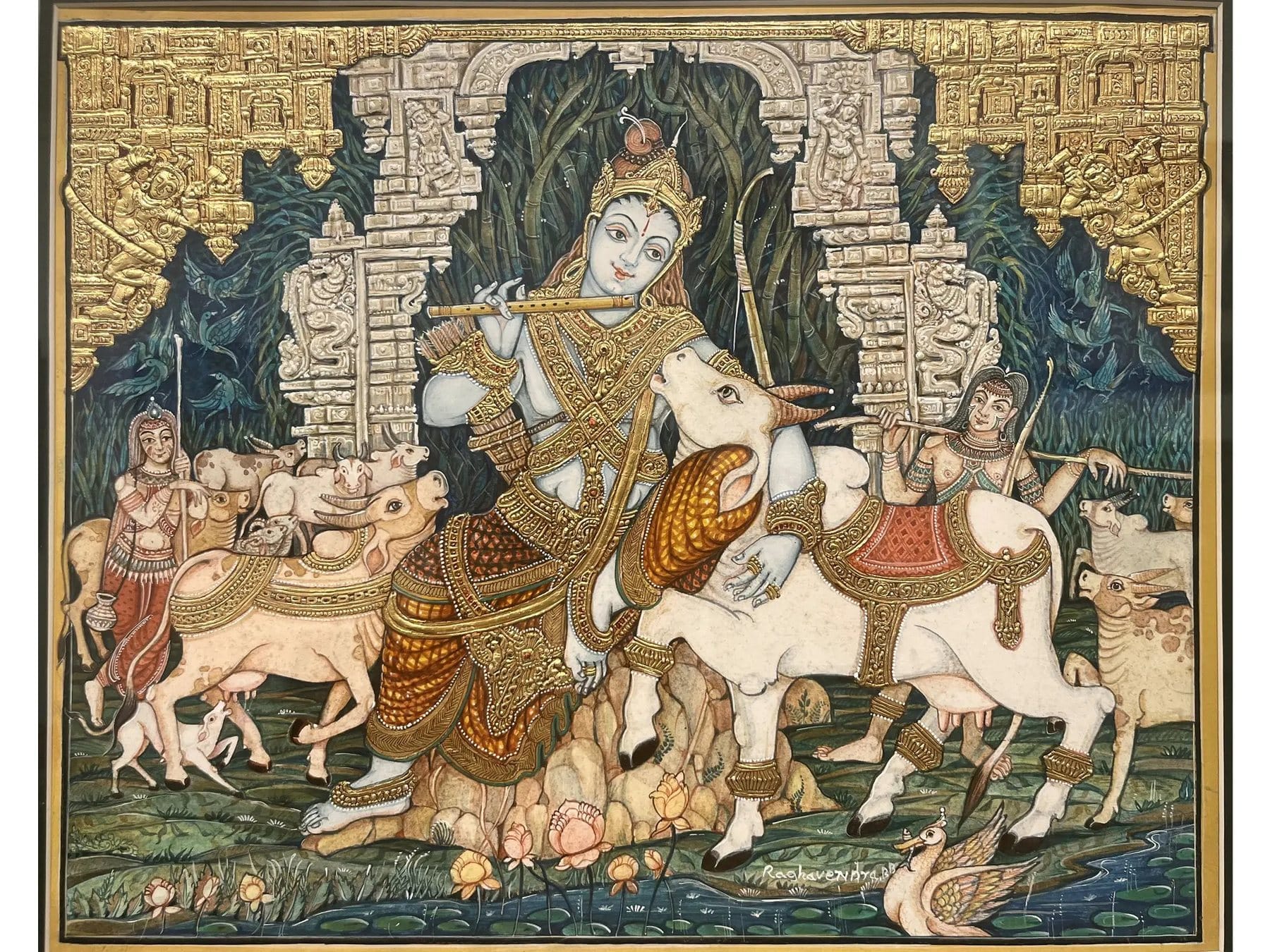
- The Kinetic, Heavy Eye: Figures are drawn in sharp profile or three-quarter view with dramatic, curved eyes that extend outward toward the temples, evoking the sculpted stone reliefs of the Vijayanagara Empire. Cheeks are rounded, waists are narrow, and hands are curved into classical dance mudras.
- Color as Divine Character: Iconography is governed by sacred color codes. Krishna and Rama are filled with deep indigo blue; celestial sages and gopis glow in warm, earthy turmeric yellow; fierce demons and kings are washed in fiery madder red; while trees and forest pastures take on rich, muted greens.
Material Anatomy & Process
The alchemy of Srikalahasti Kalamkari is an organic, seventeen-stage ritual that takes months of river washing, sun bleaching, and boiling:
- The Cotton Canvas: Coarse, handspun cotton cloth is washed in running river water to strip natural sizing. It is then soaked in a mixture of buffalo milk and dried Myrobalan nut powder (Karakkai). The milk fat prevents the liquid dyes from bleeding across the fabric, while the tannin in the myrobalan prepares the cloth to grip natural mordants permanently.
- The Bamboo Instrument (Kalam): The pen is fashioned from a sharpened bamboo reed. Below the pointed tip, the artist wraps a ball of sheep's wool or coarse yarn tied with cotton thread. When the pen is dipped into liquid ink, the wool acts as a reservoir; the artist gently squeezes the wool with their fingers to regulate the flow of ink onto the cloth.
- The Fermented Iron Ink (Kasimi): Outlines are drawn using a fermented mixture of rusted iron scraps, jaggery (cane sugar), and palm water left to ferment in earthen pots for twenty-one days. When this clear liquid touches the myrobalan-treated cloth, a chemical reaction occurs instantly, turning the iron into an indelible, permanent jet-black line.
- Natural Vegetable Color Vats:
- Red: Alizarin extracted from the crushed roots of the madder plant (Chavalikodi), boiled with alum as a fixing agent.
- Yellow: Crushed pomegranate rinds (Dhalimma) and dried myrobalan flowers.
- Blue: Natural fermented plant indigo, applied by hand in broad, calm washes.
- River Rinsing: The cloth is washed repeatedly in the flowing waters of the Swarnamukhi River, where the mineral balance of the water clears excess dye and leaves the white background gleaming.
The Literary & Spiritual Roots
Srikalahasti Kalamkari is the visual manifestation of the regional Bhakti movement:
- Pothana’s Bhagavathamu: The narrative core is drawn from Bammera Pothana’s 15th-century Telugu translation of the Bhagavata Purana. Pothana’s poetry is renowned for its tender, lyrical devotion, and Kalamkari artists translated his Telugu stanzas into immediate visual scenes of the cowherd pastimes (Gopala Lila).
- The Alvars and South Indian Vaishnavism: The tradition absorbed the ecstatic emotionalism of the Tamil Alvar saints, who viewed Krishna as an intimate, playful friend rather than a distant sovereign deity.
- The Temple Chariot Cloths: The cloths were created not for private ownership, but as offerings (Kaanuka) to be tied around towering wooden temple cars during annual Brahmotsavam processions, wrapping the entire community inside the sacred memory of Braj.
Heritage, Lineage & Field Notes
- Jonnalagadda Gurappa Chetty: The modern revival of Srikalahasti Kalamkari is inseparable from the work of Padma Shri and Shilp Guru awardee Jonnalagadda Gurappa Chetty, who preserved traditional botanical dye recipes and trained hundreds of young artists in the strict freehand technique.
- Geographical Indication (GI): Srikalahasti Kalamkari was granted Geographical Indication status in 2006 (Application No. 19), legally securing the craft’s unique status as a purely hand-drawn, botanical-dye tradition distinct from screen-printed commercial fabric.
- Key Archival Repositories:
- Government Museum, Chennai: Outstanding collection of 18th and 19th-century temple narrative cloths.
- National Handicrafts and Handlooms Museum (Crafts Museum), New Delhi: Master ceremonial scrolls by historic Kalamkari lineages.
- Victoria and Albert Museum, London: Early colonial collections of Andhra temple textiles.
In Srikalahasti, a painting is not completed by a painter standing at an easel. It is created by the river, the sun, the buffalo milk, and the rusted iron, turning the sacred pastimes of Krishna into something as enduring as the earth itself.