The Origin & Regional Context
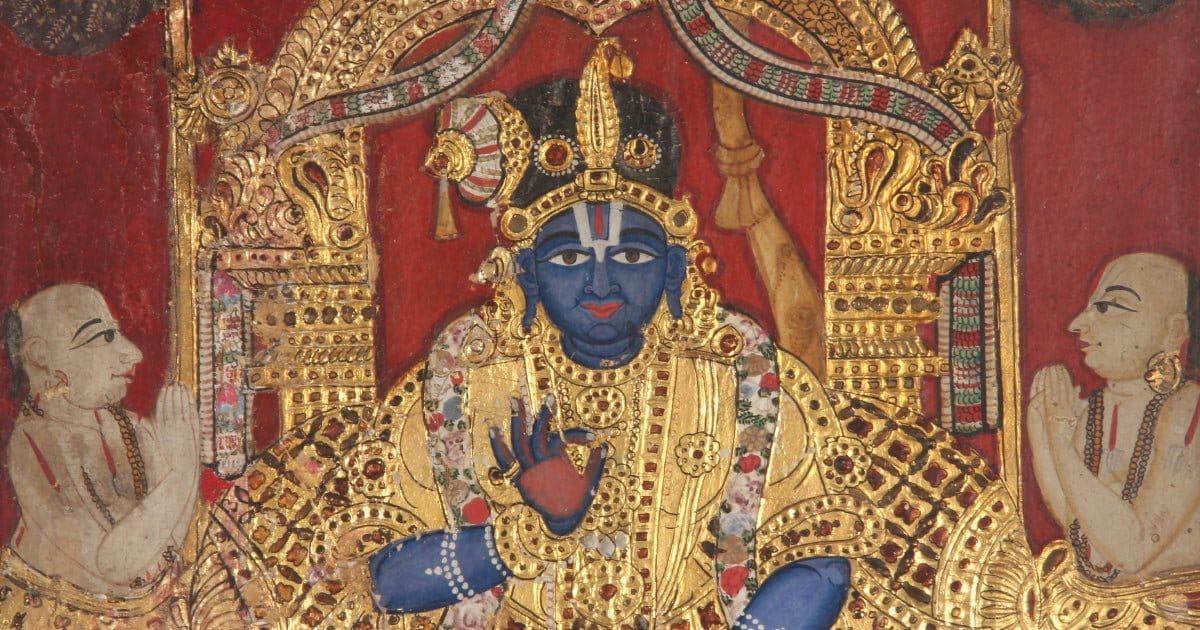
Along the fertile delta of the Kaveri River in Tamil Nadu, the historic city of Thanjavur (Tanjore) served as the cultural capital of southern empires: the Cholas, the Nayakas, and finally the Marathas. Under the Maratha rulers of Thanjavur, notably Maharaja Serfoji II (r. 1798-1832), a legendary scholar and patron of the arts, a unique, opulent school of painting reached its peak.
Following the fall of the Vijayanagara Empire, master artisans from the Raju and Naidu communities migrated south. In Thanjavur, these painters encountered a society that celebrated temple rituals and sacred classical music. Unlike miniature paintings meant to be held in albums, Thanjavur paintings were designed as monumental religious icons to be installed in temple shrines and family prayer halls. Here, the romance of Braj was translated into a majestic, glowing presence of pure gold, created to be worshipped under the flickering flames of oil lamps.
Visual Grammar & Iconography
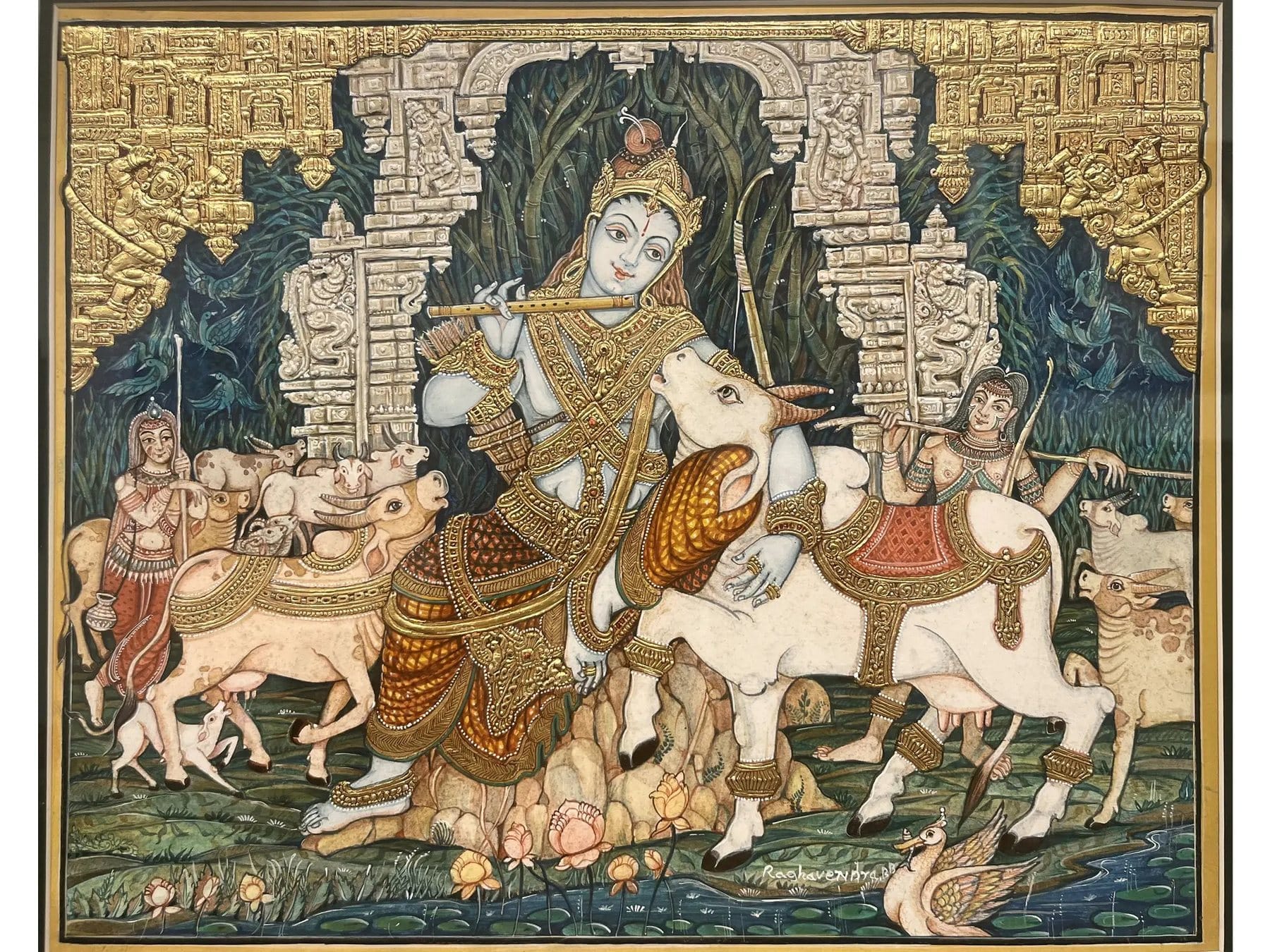
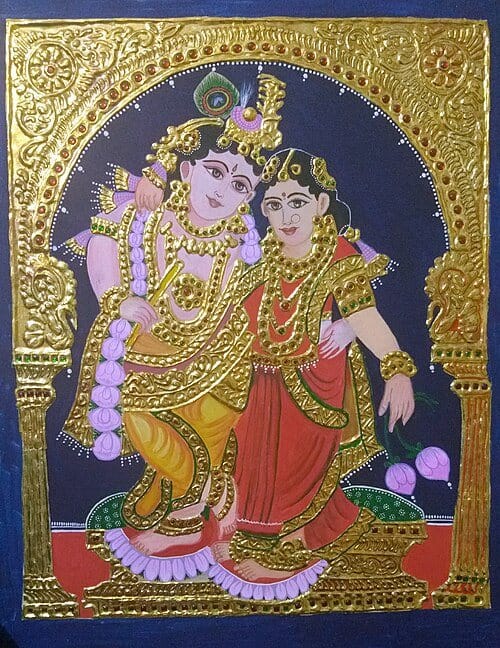
Thanjavur painting is recognized by its sculptural relief, brilliant gold illumination, and monumental figures:
- The Iconic Navaneetha Krishna: The central and most beloved subject of Thanjavur is the infant Krishna (Navaneetha Krishna). He is depicted with chubby cheeks, soft rounded limbs, and radiant porcelain-white or sky-blue skin, crawling happily across a golden carpet while clutching a ball of butter.
- Raised Gesso Relief (Sukku Work): Key architectural elements, arches, pillars, thrones, crowns, and jewelry, are not painted flat. They are built up in high, three-dimensional relief using a paste of unboiled limestone powder and glue, giving the painting a sculptural presence.
- Pure Gold Foil and Gems: The raised gesso is covered with sheets of 22-carat gold foil, meticulously incised and set with cut glass stones, rubies, and emeralds, reflecting light like a temple altar.
- The Serene, Wide-Eyed Face: Deities possess broad, round faces, small lips curved into a compassionate smile, and large, clear almond eyes that gaze outward to bestow blessing (Darshan) upon the devotee.
Material Anatomy & Process
The creation of an authentic Thanjavur panel is an exacting, multi-week craft:
- The Board (Palagai Padam): The base is crafted from seasoned jackfruit or teakwood, covered with unbleached cotton cloth pasted with cooked rice starch. The surface is coated with a mixture of crushed limestone and gum, then burnished with smooth river stones until it resembles polished marble.
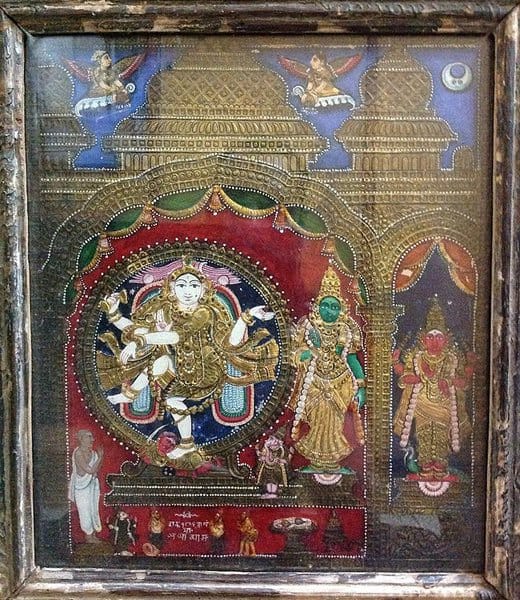
- The Gesso Paste: Fine limestone powder (sukku) is boiled with Arabic gum to create a thick, pliable paste. The artist applies this paste in multiple layers using fine brushes to sculpt ornaments and architectural details.
- Gold Leaf Gilding: Sheets of real gold foil are laid over the raised relief, pressed into the grooves, and detailed with wooden styluses.
- Mineral Color Washes
- Blue and Green: High-grade mineral blues and vegetable greens for Krishna and foliage.
- White: Dense zinc white for Krishna’s flesh in the child form.
- Red: Bright vermilion and cinnabar for textiles and backdrops.
The Literary & Spiritual Roots
Thanjavur painting was inspired by the South Indian Bhakti movement and classical Carnatic music:
- The Alvars and Divya Prabandham: The Tamil Alvar saints composed thousands of verses celebrating Krishna’s childhood pastimes in Gokula. Their songs celebrate the maternal love of Yashoda and the mischievous butter-thief, themes that Thanjavur artists translated directly onto wooden boards.
- The Krishna Leela Tarangini of Narayana Tirtha: Composed along the Kaveri delta in the 17th century, this Sanskrit opera recounts Krishna’s life from birth to his wedding with Rukmini. Its songs were sung in temples while devotees worshipped before Thanjavur icons.
- Vatsalya Bhakti (Maternal Love): Approaching God as a child allows the devotee to bypass awe and fear, replacing them with pure affection. In Thanjavur, the almighty creator of the universe is held as a baby in the lap of the devotee.
Heritage, Lineage & Field Notes
- The Raju Guilds: The craft was guarded by hereditary painters of the Raju and Naidu communities, who followed strict rules of ritual purity before beginning a panel.
- Geographical Indication (GI): Thanjavur Painting was granted Geographical Indication status in 2007 (Application No. 33), legally protecting the traditional wooden-board, gesso, and gold-foil method against cheap foil imitations.
- Key Archival Repositories
- Thanjavur Art Gallery (Tanjore Palace): Premier royal collection of historic 18th-century icons.
- Government Museum, Chennai: Outstanding historical collection of traditional palagai padam panels.
- National Museum, New Delhi: Master large-scale Thanjavur Krishna panels.
In Thanjavur, art was not an ornament for a gallery. It was an enduring altar of gold and stone, built so that the light of Braj would shine through the darkness for centuries to come.